



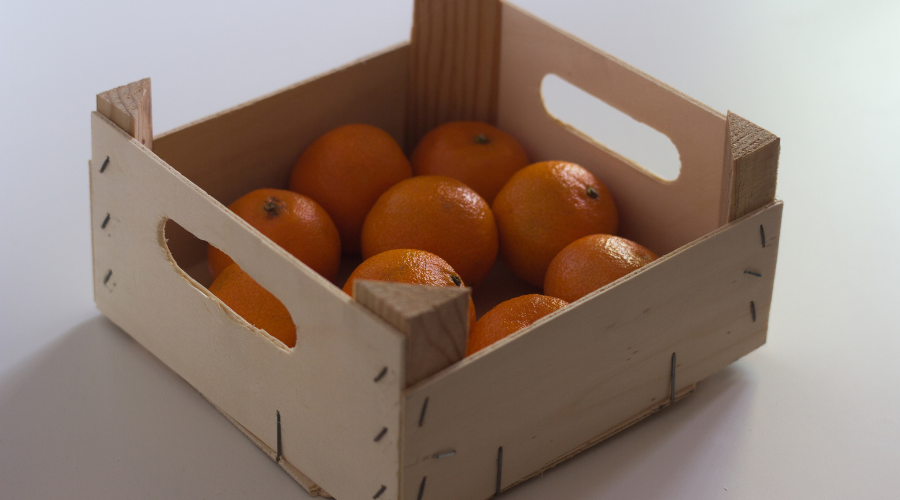
In the agri-food supply chain, food safety is not limited to production and processing stages. It extends to every element involved in handling, storage, transport, and distribution. Any material that comes into direct or indirect contact with food products can become a critical risk point if it does not meet the appropriate safety requirements.Within this context, materials used in logistics and industrial packaging play a decisive role. Choosing certified poplar plywood for food contact applications is not a secondary decision, but a strategic one that directly affects food safety, regulatory compliance, traceability, and market confidence.This article explains why using food contact safe wood is essential for the agro-industry, the risks associated with non-certified wood, the natural suitability of wood when properly manufactured, and the added value of AIDIMME food contact safety certification—a less widely known but highly relevant certification in this sector.
The risks of using non-certified wood in food logistics
Wood is widely used in agro-industrial logistics due to its strength, versatility, and efficiency. However, not all wood products are suitable for food-related applications. Using non-certified wood can create significant risks.One of the main concerns is microbiological contamination. Wood that has not been manufactured under controlled conditions may harbor bacteria, fungi, or mold, especially in environments with humidity fluctuations or temperature changes, which are common in food logistics.Another critical risk is the presence of chemical residues. Adhesives, treatments, or manufacturing substances used in non-food-grade plywood may migrate into food products or their packaging, compromising food safety.Moisture control is also a key factor. Poorly dried wood or plywood without proper industrial processing may deform, retain moisture, and become difficult to clean, increasing hygiene risks.Finally, the absence of certification usually means lack of traceability, which can create serious issues during audits, inspections, or quality claims.Why poplar plywood is a suitable solution for the agro-industry
When manufactured under controlled industrial processes and supported by specific certification, poplar plywood offers several advantages for agro-industrial logistics.Poplar wood is lightweight, stable, and homogeneous, making it ideal for packaging, supports, platforms, and logistics components. Its multilayer structure, when properly pressed and bonded, minimizes deformation and surface defects where contaminants could accumulate.These natural properties only become truly valuable when combined with food contact certification, which confirms that the plywood is suitable for use in sensitive food-related environments.The natural suitability of wood for food contact applications
Properly manufactured and certified wood is a chemically stable and low-reactivity material. When produced using food-safe adhesives and controlled processes, it does not release harmful substances during contact with food or food packaging.Wood also offers excellent mechanical performance, protecting products during handling and transport. This stability is especially important in agro-industrial logistics, where product integrity must be preserved throughout the supply chain.However, these benefits are only guaranteed when the wood has been specifically assessed and certified for food contact use.AIDIMME certification: a key differentiator for food contact safety
The AIDIMME food contact safety certification is particularly relevant for the agro-industry, although it remains relatively unknown outside technical environments. This certification evaluates the suitability of wood-based materials for direct or indirect contact with food.For certified poplar plywood, AIDIMME confirms compliance with strict criteria related to substance migration, hygienic behavior, and compatibility with food-contact applications.Holding this certification provides clear advantages:- Documented food safety compliance
- Greater confidence during audits and inspections
- Improved traceability and regulatory alignment
- Clear differentiation from non-certified alternatives
Applications of certified poplar plywood in agro-industrial logistics
Certified food grade plywood is particularly recommended for:- Packaging and crates for fruits and vegetables
- Logistic platforms and handling systems
- Storage and transport components in food supply chains
- Industrial packaging with direct or indirect food contact