When a company manufactures fronts, sides, interiors or visible components, choosing poplar plywood for painting and laminating is not a minor decision. It directly affects machining, surface finish, production times and the total cost of each batch. In sectors such as kitchen furniture, wardrobes and technical carpentry, the panel must perform well in CNC machining, provide a consistent face for lacquering or HPL bonding, and remain stable throughout the entire industrial process. This is where CATENVA, as a plywood manufacturer specialized since 1984, brings real value through custom manufacturing, process control, technical support and a clear focus on adapting each panel to its final application.

Table of contents

  1. What a panel really needs when the final application is painting or laminating
  2. Why poplar plywood for painting and laminating improves machinability
  3. The importance of a clear and uniform face in lacquering, melamine and HPL processes
  4. How dimensional stability affects the final quality of furniture
  5. The hidden cost of choosing panels based only on price
  6. What a manufacturer should require from their supplier to avoid rework and downtime
  7. CATENVA’s role as a technical manufacturer in furniture and wardrobe projects

What a panel really needs when the final application is painting or laminating

In many industrial projects, a common mistake is to assume that a panel for painting or laminating only needs to “look good”. In reality, when the final application involves lacquering or covering with melamine or HPL, the panel must perform consistently across the entire production chain. It must enter machining in stable condition, accept calibration without generating critical deviations, maintain reasonable tolerances, support the adhesion of finishing systems and reach assembly without deformation that compromises the visual quality of the finished product.Many production issues begin when the final application is not clearly defined from the start. A non-visible structural component is not the same as a light-coloured lacquered door, a side panel that will receive decorative laminate or a front where any shadow, pore irregularity or base defect will eventually become visible. When this definition is missing, purchasing departments often compare panels only by unit price, without considering how each option affects sanding, paint consumption, bonding performance, rejection rates in finishing and later rework.The consequences appear quickly on the shop floor. A panel with surface irregularities, excessive visual heterogeneity or unstable behaviour requires more preparation, more corrections and more time in a stage that should be repeatable. That reduces productivity, complicates planning and increases the cost of the finished component, even when the initial purchase price appeared more competitive.The right approach is to treat the panel as a process base rather than as a generic raw material. In that context, poplar plywood for painting and laminating stands out because it combines visual consistency, lightness, machinability and good finishing performance. Depending on the final use, it is advisable to verify face quality, composition, moisture content, tolerances and compatibility with the coating system, but the criterion should remain the same: select the panel that reduces production risk and improves the final result.

Why poplar plywood for painting and laminating improves machinability

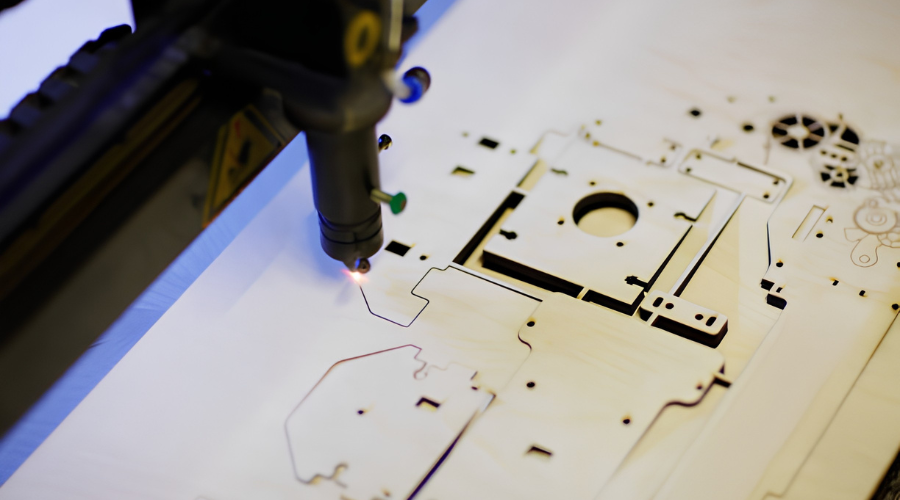
Machinability is not always the first commercial argument, but in industrial production it is one of the most profitable. A panel may look acceptable at first glance and still generate repeated issues during cutting, drilling, routing, grooving or edging. When this happens, the problem is rarely limited to the machine itself. In many cases, it starts with the selection of a substrate that was not chosen with the full production process in mind.In applications such as kitchens, wardrobes and technical furniture, good machinability means that the tool works consistently, edges come out cleaner, chipping is reduced and operators do not need to constantly compensate for material deviations. In panels with dark knots, resin pockets or greater visual and structural irregularity, this consistency can suffer both in machining behaviour and in the uniformity of the final surface finish.Poplar offers an important advantage here. Its lightweight structure and favourable machining response support more predictable cycles, which is especially relevant in long production runs or repetitive part manufacturing. When the panel performs well in CNC machining and allows cleaner processing, manual corrections are reduced, cycle times are shortened and unnecessary process adjustments are minimised. This directly affects production costs, output per shift and the ability to meet delivery deadlines.Ignoring machinability can be expensive. A manufacturer may buy a panel that seems competitive on paper, but if it requires more sanding, more edge correction or more part rejection before finishing, the hidden cost spreads across the entire production process. In addition, when machining leaves micro-defects or surface irregularities, the problem becomes even more visible once lacquer or laminate is applied, because the finish does not hide the defect. It reveals it.That is why machinability should be assessed as a real economic factor. At CATENVA, we work from that technical logic. We do not simply supply plywood. We help define the right solution according to machining requirements, weight, resistance and final use, which is especially important in projects where surface finish directly influences the perceived quality of the final product.

plywood for laminating

The importance of a clear and uniform face in lacquering, melamine and HPL processes

Aesthetics is not a secondary issue when a panel is going to be painted or laminated. In many industrial processes, a uniform face means less preparation, fewer corrections and greater visual consistency from batch to batch. This is one of the main advantages of poplar compared to alternatives where dark knots, strong colour variation or more problematic areas make it harder to achieve a homogeneous base.The issue arises when it is assumed that any panel can receive the same surface treatment and deliver the same result. In lacquering, an irregular substrate may require more sealing, more sanding and more coats to reach the quality standard expected by the customer. In HPL or melamine lamination, a less uniform surface may affect the visual cleanliness of the result, the regularity of adhesion or the quality perception in critical areas such as doors, exposed sides or high-visibility interior panels.The reason is straightforward. Finishing does not work independently from the substrate. The substrate influences adhesion, absorption, uniformity and final visual response. The more stable and consistent the face is, the more controlled the process becomes. On the other hand, when the base already contains defects or marked contrasts, the manufacturer ends up investing additional time to compensate for them. That time is not always visible as a direct unit cost, but it appears in delayed production, lower finishing booth productivity, repeated work and greater difficulty maintaining stable standards across references.Poplar plywood for painting and laminating is particularly valuable because of that combination of visual clarity and regularity. For kitchen and wardrobe manufacturers, where repeatability matters as much as appearance, this characteristic helps simplify the process and reduce variation. Choosing the right face quality does not only improve appearance. It also reduces rework, avoids inconsistencies between batches and supports finishing performance from the first pass.Our recommendation is not to simply ask for “a panel for lacquering”. It is better to define from the beginning whether the priority is high-end lacquering, decorative lamination, HPL bonding or a combination of processes. It is also important to validate what level of face quality the component truly needs according to visibility and aesthetic requirements. When that conversation takes place with a manufacturer that controls its own process, the decision stops being generic and becomes aligned with the industrial result the customer is actually trying to achieve.

How dimensional stability affects the final quality of furniture

In furniture, kitchens and wardrobes, dimensional stability is one of those factors that only gets proper attention when it fails. A panel may enter production in apparently good condition and still deform, react poorly to humidity changes or compromise final assembly if it does not remain sufficiently stable. In components that need precise fitting or must support demanding finishes, this affects both visual quality and functionality.Most problems come from two common mistakes. The first is assuming that all panels behave in the same way and that any substrate can be used in any production environment. The second is failing to control material moisture and storage conditions before machining and finishing. When a panel enters the finishing booth or press out of condition, or when its structure does not provide sufficient stability, tensions, variations and defects begin to appear and later become visible in the assembled part.Because of its cross-laminated construction, plywood is generally associated with good dimensional stability when it is properly specified for the application. In the case of poplar, this advantage is combined with lightness and ease of transformation, which makes it especially suitable in furniture and interior components where reducing weight matters without compromising consistency. At CATENVA, we insist on adapting the panel to its final use through process control and technical support, because stability depends not only on the raw material itself but also on how it is manufactured, stored and integrated into the customer’s production process.The recommendation here is clear. Moisture content, storage conditions, tolerances and the actual requirements of the part should be checked before approving a panel reference. Making the right choice at this stage prevents cumulative problems in machining, finishing and assembly. Making the wrong choice may seem like a small deviation at first, but it often turns into unproductive hours, constant adjustments and a loss of confidence from the final customer.

The hidden cost of choosing panels based only on price

One of the most common mistakes in industrial purchasing is to evaluate a panel almost exclusively by price per square metre or per unit. That approach may seem reasonable in a comparison sheet, but it ignores variables that weigh much more heavily in total cost: surface preparation time, consumption of coatings or adhesives, actual machining speed, rejection rates, rework and batch-to-batch consistency.The reason this happens is often a lack of connection between purchasing, production and quality. When the buyer does not have full visibility of how the panel behaves in the line, the lowest entry price tends to be rewarded even if that option creates more friction on the factory floor. The problem is that friction does not disappear. It simply moves. What is saved during purchasing is later paid in the finishing booth, in the press, in machining, in assembly or even in after-sales claims.In kitchen or wardrobe components, where the part must look good and be produced repeatedly, an unsuitable base multiplies silent costs. More sanding is needed, more corrections are made, more work is repeated and more material is wasted. Machine time and skilled labour are also consumed in tasks that add no value and only compensate for a poor initial choice. When this happens regularly, the accumulated economic impact easily exceeds any difference in purchase price.Poplar plywood for painting and laminating can be highly competitive precisely because it helps reduce that hidden cost when it is correctly selected for the application. Its clearer and more uniform face can simplify the lacquering or decorative bonding process, while its machinability supports more stable production cycles. This does not mean that one solution fits every use, because it always depends on the application, but it does mean that in many production lines the best purchase is not the cheapest one. It is the one that creates fewer incidents and greater repeatability.

poplar-plywood-painting-laminating

What a manufacturer should require from their supplier to avoid rework and downtime

When a company works with lacquering, HPL or melamine, the plywood supplier should not be limited to delivering a reference code. The supplier should be capable of understanding the application, anticipating risks and supplying a material that is coherent with the production process. The problem is that many incidents begin with an incomplete specification. Thickness and dimensions are requested, but face quality, machining type, aesthetic requirement, expected finishing behaviour and storage or service conditions are not properly defined.The consequence of that lack of definition is that the panel arrives, enters the production line and then has to be adapted afterwards to a need that was never fully specified. That is when disputes appear over adhesion, tolerances, moisture, batch consistency or defects that were actually foreseeable from the beginning. The result is downtime, rework and unnecessary tension between supplier and customer.The solution is to work with a technical logic from the outset. A furniture or wardrobe manufacturer should ask not only for plywood, but for suitability to the final use. That means discussing machinability, surface quality, lacquering or laminating requirements, dimensional stability, traceability and supply consistency. It may also involve reviewing whether the project requires certifications or documented quality frameworks, such as quality systems or chain of custody certification, because in many B2B markets that documentation already forms part of the purchasing decision. At CATENVA, this is exactly how we work. We manufacture to specification, control the process, provide technical advice and work with certifications such as ISO 9001, PEFC or FSC where relevant.The real impact of working this way is very clear. Uncertainty is reduced before production begins, variation in serial manufacturing is minimised and process predictability improves. Instead of solving problems when the part is already in the finishing booth or in assembly, the aim is to prevent those problems from entering the factory in the first place. That is one of the main differences between simply buying plywood and developing a technical solution.

CATENVA’s role as a technical manufacturer in furniture and wardrobe projects

In sectors such as kitchens, wardrobes and technical interior design, it is not enough to find a panel that is merely acceptable. A manufacturer is needed who understands that each application imposes different priorities. Some projects place more weight on lightness, others on finishing quality, others on machinability as the main bottleneck, and others on supply consistency to avoid production stops. The advantage of working with a specialised manufacturer is that this analysis becomes part of the solution.At CATENVA, we are a plywood manufacturer with industrial experience, custom manufacturing capability, process control, certification and adaptation to customer requirements. This approach is especially useful when a reliable base is needed for painting or laminating, because final quality does not depend on a single isolated factor. It depends on how face quality, machinability, dimensional stability, moisture, tolerances and batch regularity are combined.In practice, this creates a much more useful relationship for the industrial customer. Instead of buying blindly and correcting later, the manufacturer can define with technical support which panel is needed according to the production process, finishing system and required aesthetic standard. This reduces common mistakes such as ignoring machining conditions, assuming that all faces behave the same in lacquering, failing to validate moisture or choosing only by price. It also improves the final quality of the finished product and reduces rework that affects both margins and delivery times.When the goal is to manufacture kitchen furniture or wardrobes with a clean, homogeneous and repeatable presentation, poplar plywood for painting and laminating becomes an especially efficient base. Not only because of how it looks, but because of everything it simplifies behind the scenes: machining, preparation, adhesion, stability and productivity. And when it is sourced from a manufacturer that controls process and traceability, the decision becomes stronger both technically and economically.

Conclusion

At CATENVA, we know that choosing the right poplar plywood for painting and laminating directly affects production performance. A uniform face, good machinability and proper dimensional stability help reduce defects, rework and unnecessary costs.As manufacturers, we see every day how poor panel selection can lead to more adjustments, lower finishing quality and more production issues. That is why we develop solutions adapted to lacquering, melamine lamination or HPL bonding, defining each panel according to final use, machining requirements and the expected aesthetic standard. If your company is looking for a more reliable solution for painting and laminating applications, our technical team can help define the most suitable plywood according to the real needs of your project.

FAQ

1. Is poplar plywood always the best option for painting and laminating?

It depends on the application, the finishing system and the required aesthetic standard. In many kitchen, wardrobe and technical interior projects, it stands out because of its clear face, visual uniformity and good machinability, but face quality, thickness and final use conditions should always be verified.

2. Why does machinability affect total production cost so much?

Because a panel that machines well reduces chipping, manual corrections, unproductive time and unnecessary process wear. Even if its purchase price is not the lowest, it can be more cost-effective by reducing rework and rejected parts.

3. What problems appear if panel moisture is not properly controlled?

Deformation, dimensional variation, adhesion issues and assembly or finishing problems may occur. In painting and laminating processes, poor moisture control affects both final quality and production stability.

4. What is the value of working with a manufacturer like CATENVA instead of buying a standard reference?

It means access to custom manufacturing, process control, technical support, traceability and the ability to adapt the plywood to the final application. This helps define the right solution and reduces incidents in machining, finishing and assembly.

Privacy Preference Center