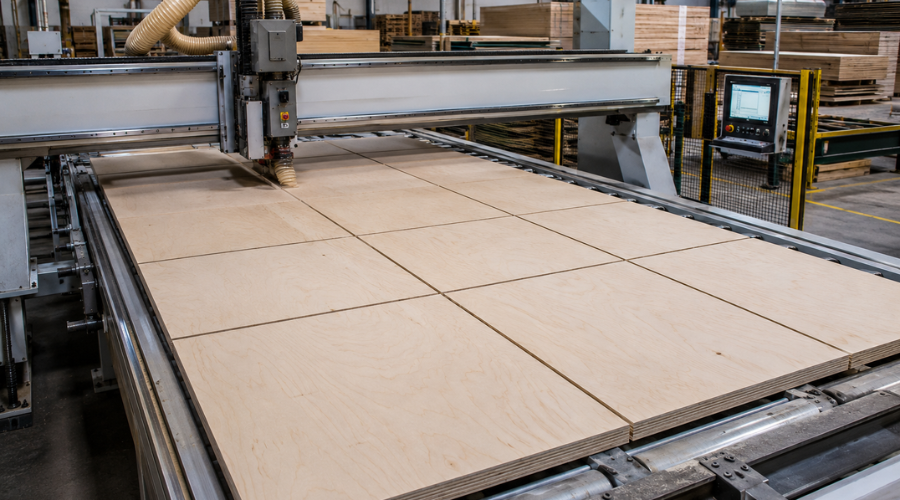
Standard vs. custom plywood panel sizes is one of the most underestimated decisions in industrial carpentry, despite its direct impact on production efficiency, real costs, and final product quality. In many industrial environments, companies continue to rely on standard formats out of habit, without analyzing whether they are truly compatible with the process, machining requirements, or end use.The usual result is not immediate, but cumulative: material waste, unnecessary machining time, dimensional stability issues, and increased rework. Choosing correctly between standard and custom sizes is not a commercial matter, but a technical one.At CATENVA, we work daily with companies facing production issues directly derived from this decision. That is why understanding when a standard panel is sufficient and when custom manufacturing is required becomes a key factor in optimizing industrial processes. 

What does it mean to work with standard plywood panel sizes?

Working with standard plywood panel sizes is often perceived as a simple and cost-effective solution. However, this perception is more aligned with supply logic than with production logic.The problem arises when the standard format is not aligned with the product design or manufacturing process. The main reason is that standard sizes are designed to facilitate mass production of the panel itself, not to adapt to each specific industrial application.The direct consequence is that the customer must adapt their process to the panel, instead of the panel adapting to the process. This leads to additional cutting, production line adjustments, and, in many cases, loss of usable material.From a production standpoint, this creates clear inefficiencies. Machining time increases, tool wear intensifies, and variability in tolerances is introduced. In terms of quality, these deviations can result in assembly issues, irregular finishes, or difficulties in subsequent processes such as lacquering or laminating.In terms of cost, the impact goes beyond the price of the panel itself. Material waste, additional processing time, and rework often exceed the initial perceived savings. In repetitive production environments, this impact multiplies.It is essential to verify whether the use of standard sizes truly fits the product design. In many cases, choosing based on initial price leads to the assumption that all panels are the same, when in reality dimensional adaptation is a critical factor.

Real limitations of standard sizes in industrial environments

The limitations of standard plywood panel sizes are not always evident during the purchasing phase, but they become clear in production.One of the most common issues is the lack of optimization in cutting layouts. When the panel format does not match the dimensions of the final parts, leftover material is generated, which is not always reusable. This situation is especially critical in sectors such as packaging, furniture, or industrial crates.The root cause is often a failure to properly define the application from the outset. Many companies purchase standard panels without validating actual performance in their production process. This leads to reactive decisions, where the process is adjusted afterward.The direct consequence is an increase in cost per produced unit. Even if the panel price is lower, the cost per usable part rises due to waste and additional labor time.In production, this also affects planning. Cutting, sorting, and adjustment times slow down the line and create bottlenecks. Additionally, variability in parts can impact assembly quality, especially when tolerances and material moisture have not been properly controlled.Another common mistake is not considering machining requirements from the beginning. Plywood has specific machinability characteristics that must be taken into account. If the format is not suitable, cutting behavior can lead to edge defects, splintering, or deviations.From a technical perspective, standard sizes limit the ability to optimize material performance. In industrial environments, this limitation translates into a loss of competitiveness.

Technical advantages of custom plywood panel sizes

Custom plywood panel sizes directly respond to an industrial need: adapting the material to the process, not the other way around.The main issue they solve is the misalignment between panel format and final product. By manufacturing to size, unnecessary intermediate cuts are eliminated and material utilization is optimized.The advantage lies in prior design. When the application, machining type, tolerances, and end use are analyzed, it is possible to define a panel that fits perfectly into the production process.The result is a direct improvement in efficiency. Machining times are reduced, waste is minimized, and part consistency is improved. This positively impacts final quality, especially in subsequent processes such as assembly, lacquering, or laminating.In terms of cost, although the unit price of the panel may be higher, the total production cost decreases. Less waste, less processing time, and fewer reworks generate real savings.Additionally, custom sizes allow better control of technical aspects such as dimensional stability and moisture content. This is critical in applications where panel behavior directly affects final product performance.At CATENVA, we manufacture custom plywood panels by analyzing each application. We adapt dimensions, compositions, and finishes to ensure the panel performs within the customer’s process, not outside of it.

Direct impact on costs, time, and rework

The decision between standard vs. custom plywood panel sizes has a direct impact on the cost structure of any industrial process.The problem is that many companies evaluate cost solely based on the panel’s purchase price. The root cause of this mistake is failing to consider the total cost of ownership.The consequence is that factors such as waste, machining time, and rework are underestimated. These elements, although less visible, have a significant cumulative impact.In production, using non-optimized sizes generates additional cutting and adjustment time. This affects line productivity and may require more labor or additional shifts.In terms of quality, errors resulting from poor dimensional fit can lead to rejections or returns. This not only increases costs but also affects product perception.Rework is another critical factor. When parts do not fit properly or present defects, manual intervention is required, increasing time and reducing efficiency.In contrast, when working with custom sizes, these problems are significantly reduced. Production becomes smoother, quality more consistent, and costs more controlled.From our experience as manufacturers, we see how this decision can make the difference between an optimized process and one full of hidden inefficiencies.

How to choose between standard and custom depending on the application

Choosing between standard vs. custom plywood panel sizes depends directly on the application, production volume, and level of technical requirement.The problem arises when this decision is made without prior analysis. The cause is often the assumption that standard is sufficient in all cases.The consequence is the emergence of problems that could have been avoided with proper planning. This includes everything from material waste to failures in the final product.In simple or low-volume applications, standard sizes may be sufficient. However, in industrial production, where repeatability and efficiency are key, custom solutions are usually the most appropriate option.It is important to verify aspects such as machining type, required tolerances, behavior under humidity, and dimensional stability. It is also essential to consider subsequent processes such as lacquering or laminating, which can be affected by small deviations.A common mistake is not validating face quality or not considering how the panel will be processed. This can lead to problems in finishes or material adhesion.At CATENVA, we advise our clients to define the best solution in each case. We analyze the end use and adapt the panel to ensure optimal performance in production.

The role of the manufacturer in optimizing plywood panel performance

The plywood manufacturer should not be just a supplier, but a technical partner in the industrial process.The problem is that many companies purchase panels without technical support. The cause is treating the material as a commodity, when in reality it is a critical component of the process.The consequence is missed optimization opportunities. Without technical analysis, it is difficult to identify improvements in efficiency, quality, or cost.The manufacturer has the ability to adjust parameters such as dimensions, composition, wood type, and finishes. This allows the panel to be adapted to the specific needs of each application.In addition, production control and traceability are key factors in ensuring supply consistency. Certifications such as ISO 9001 or PEFC provide assurance in this regard.At CATENVA, we work as a partner. We not only manufacture plywood panels, but we also analyze each project to offer tailored solutions. We control the process, ensure traceability, and provide technical support at every stage.If you are evaluating how to improve your production process, it is worth reviewing whether the panel you are using is truly adapted to your application.At CATENVA, we can help you analyze your case and define the best plywood solution, tailored to your real production needs.

FAQ

When is it advisable to use standard plywood panel sizes?

Standard sizes are only a valid option when the product design is fully aligned with the panel format, which is not always the case in industrial environments. They are suitable when cutting layouts fit without generating significant waste and when machining requirements are low or non-critical. The problem arises when they are used by default: in those cases, hidden costs related to material waste, cutting time, and manual adjustments can clearly exceed initial savings. In repetitive production, this misalignment amplifies, affecting overall line efficiency. That is why it is essential to simulate real panel performance within the production process before making a decision.

How can you calculate whether custom sizes are more cost-effective than standard ones?

You should not compare only the price per panel, but the cost per usable part produced. To do this properly, it is necessary to analyze cutting yield, machining time, waste percentage, and the impact of rework. When working with standard sizes, it is common to lose usable surface and increase intermediate operations. In contrast, with custom sizes, the panel is optimized for the process, reducing cuts, time, and errors. In many cases we analyze at CATENVA, the total cost difference is significant, especially in medium and high production volumes, where small inefficiencies become structural costs.

What specific problems occur in production when plywood panels are not adapted?

The most common issues are not detected during purchasing, but on the production line. Machining deviations, assembly difficulties, and defects in finishes such as lacquering or laminating frequently appear. Edge splintering or inconsistencies caused by internal stresses in the panel are also common when cuts were not initially planned. Operationally, this results in more adjustment time, increased tool wear, and the need for manual intervention. The final outcome is reduced production flow and increased rework, directly impacting costs and delivery times.

Do custom plywood panel sizes also improve final product quality?

Yes, and more directly than is often assumed. When the panel is dimensionally adapted to the final use, stresses, deformations, and accumulated process errors are reduced. This improves dimensional stability, which is critical in products where precision and fit are essential. Additionally, by minimizing additional cuts, face and edge quality are better preserved, facilitating subsequent processes such as lacquering, bonding, or laminating. From an industrial perspective, this reduces rejections and returns, improving product consistency and perceived quality.

Privacy Preference Center