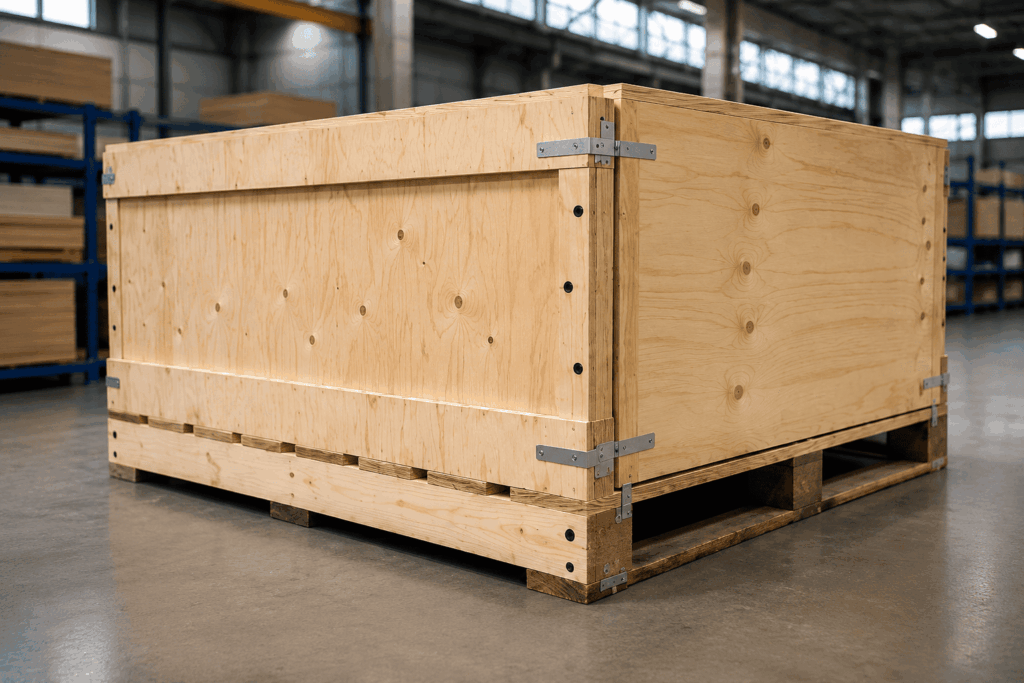
Choosing a custom industrial plywood manufacturer for industrial applications is a decision that directly impacts the quality of the final product, production efficiency, and the overall profitability of any project. In sectors such as industrial packaging, construction, transportation, the agri-food industry, technical furniture, and industrial carpentry, plywood panels should not be considered a generic raw material, but rather a technical solution designed to meet specific application requirements.However, it is still common to find projects where plywood panels are selected solely based on price or immediate availability.This approach often leads to problems that only become apparent during production, including machining difficulties, deformation, material waste, quality issues, and manufacturing delays. What initially appears to be a cost-saving measure frequently results in higher operating costs and reduced competitiveness.Plywood panels offer well-known advantages in industrial applications thanks to their combination of strength, lightweight properties, and dimensional stability. Nevertheless, to fully benefit from these characteristics, the product must be adapted to the specific requirements of each application.At CATENVA, we have been manufacturing plywood panels since 1984, and we understand that the needs of an industrial packaging company differ significantly from those of a technical furniture manufacturer or a transportation company. For this reason, customization, technical support, and process control are essential factors in ensuring reliable and consistent results. Moisture is another common source of problems. Although plywood is known for its dimensional stability, it remains a wood-based product whose performance is influenced by environmental conditions. If moisture is not properly controlled during storage, transportation, or installation, deformation may occur, affecting both functionality and appearance.In demanding industrial applications, it is also common to overlook the tolerances required for proper assembly. Small dimensional variations can create cumulative problems that impact the entire production line.The economic consequences often extend far beyond the initial material cost. Companies frequently face increased expenses related to returns, delays, claims, waste, and productivity losses. For this reason, plywood panel selection should be viewed as a strategic decision rather than a simple procurement purchase.
Why Customization Is Essential in Industrial Plywood Panels
Industrial plywood panels are used in environments where performance requirements are often demanding. Although two projects may appear to use the same material, their actual operating conditions can be completely different. This is one of the main reasons why customization has become a critical factor in achieving satisfactory results.When the final application is not properly defined, companies often select panels that fail to meet the project's real requirements. This is especially common when purchasing decisions are based exclusively on economic criteria. The problem arises once the panel enters production and begins to reveal limitations related to machining, dimensional stability, or required mechanical strength.The primary cause is usually a lack of preliminary analysis. Every industry has specific requirements concerning mechanical loads, environmental humidity, dimensional tolerances, surface finishes, and downstream manufacturing processes. Ignoring these factors can lead to deviations that negatively affect both the product and the production process.The consequences can be significant. An unsuitable panel may require additional adjustments, increase material waste, and cause issues during assembly or end-use operations. In mass production environments, these seemingly minor deviations often multiply as production volumes increase.The solution lies in adapting dimensions, thicknesses, core composition, face quality, and finishes to the actual conditions of use. Custom manufacturing makes it possible to optimize panel performance according to the customer's objectives while minimizing the risks associated with generic solutions.From an economic perspective, this strategy also delivers benefits. A panel designed for a specific application reduces rework, improves productivity, and facilitates process standardization. As a result, the total project cost is often lower than that of an apparently cheaper but technically inadequate alternative.Problems Associated with Using Standard Panels in Industrial Applications
One of the most common mistakes in industry is assuming that all plywood panels perform similarly. Although they may appear equivalent on the surface, differences in composition, quality, manufacturing methods, and production control can lead to very different results.A frequent issue arises when machining requirements are not properly evaluated. Many industrial applications involve cutting, routing, drilling, or CNC machining operations. If the panel is not designed to withstand these processes efficiently, defects increase, tool wear accelerates, and non-productive time rises.Another critical aspect is face quality. When the final product requires painting, printing, laminating, or coating, surface characteristics become extremely important. Poor panel selection can lead to visible defects, adhesion problems, and additional surface preparation costs.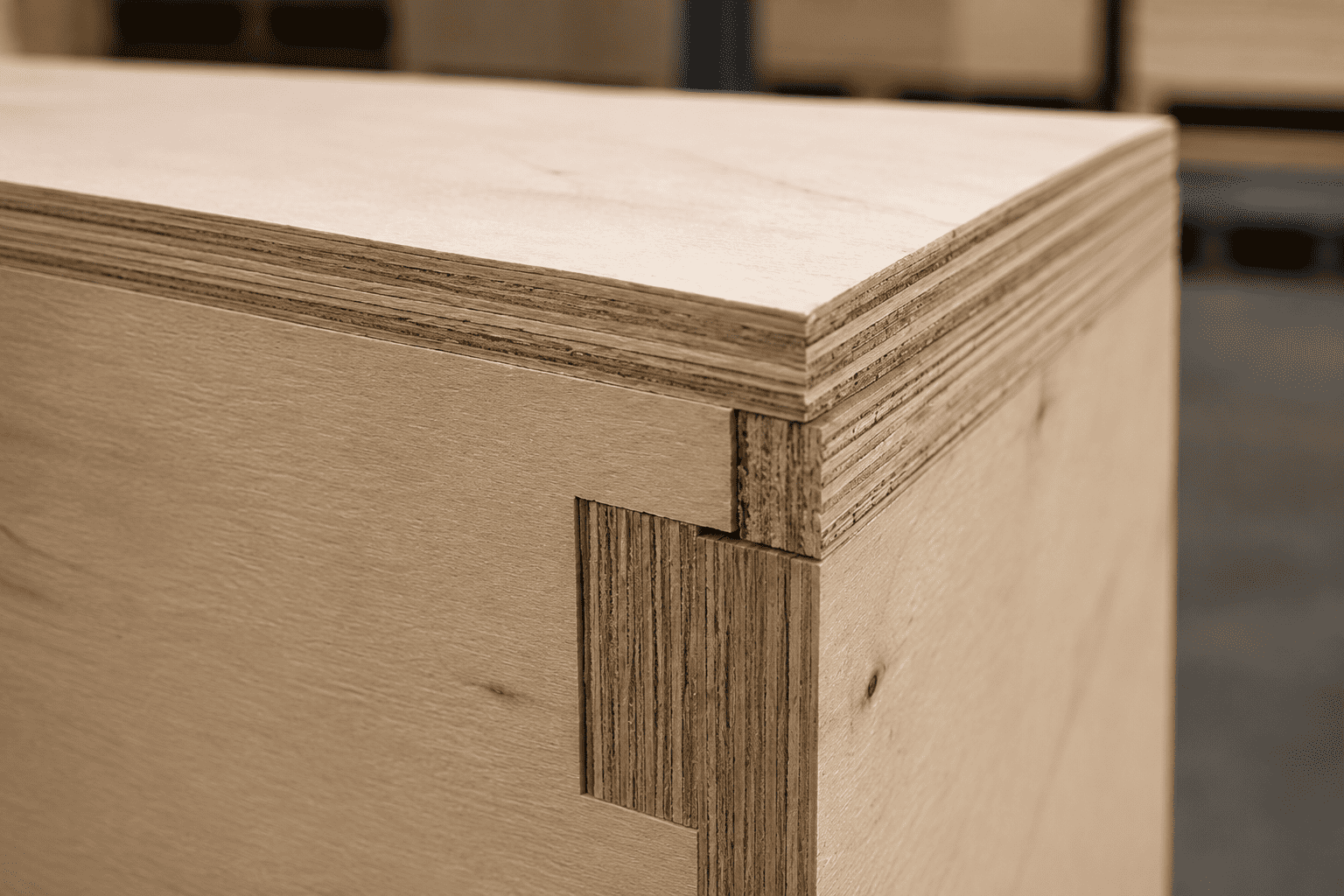 Moisture is another common source of problems. Although plywood is known for its dimensional stability, it remains a wood-based product whose performance is influenced by environmental conditions. If moisture is not properly controlled during storage, transportation, or installation, deformation may occur, affecting both functionality and appearance.In demanding industrial applications, it is also common to overlook the tolerances required for proper assembly. Small dimensional variations can create cumulative problems that impact the entire production line.The economic consequences often extend far beyond the initial material cost. Companies frequently face increased expenses related to returns, delays, claims, waste, and productivity losses. For this reason, plywood panel selection should be viewed as a strategic decision rather than a simple procurement purchase.
Technical Criteria for Selecting a Custom Industrial Plywood Panel
Selecting a custom industrial plywood panel should always begin with a detailed analysis of the final application. The more accurate the analysis, the greater the opportunity to optimize costs and ensure consistent results.One of the first factors to evaluate is the required mechanical strength. Depending on the end use, the panel may be subjected to static loads, impacts, vibrations, or continuous stresses. The internal structure and configuration of the panel must be designed to meet these demands throughout its service life.Dimensional stability is another essential criterion. In industrial applications, maintaining consistent dimensions is critical for assembly accuracy and product quality. Variations caused by changes in temperature or humidity can directly affect productivity and generate additional costs.Weight should also be carefully considered. In industries such as transportation and industrial packaging, the strength-to-weight ratio directly influences logistics costs and operational efficiency. Selecting a panel that delivers the required performance without unnecessary weight can provide significant competitive advantages.Machinability is another key factor. A panel that performs consistently during processing allows for more precise finishes, reduced machining times, and lower tool wear. This aspect is particularly important in automated production environments.Finish requirements must also be analyzed. Depending on the application, paints, laminates, printed surfaces, or specialized coatings may be required. In such cases, surface quality and panel uniformity directly influence the final result.Finally, applicable regulatory and documentation requirements should be verified. Depending on the industry and destination market, certifications related to quality, sustainability, traceability, or safety may be necessary. Certifications such as ISO 9001, PEFC, or FSC can provide valuable assurance for specific projects and approval processes.How Custom Manufacturing Impacts Costs, Quality, and Productivity
There is a common perception that customization automatically increases costs. However, when the overall impact on production is considered, the reality is often quite different.The main limitation of standard panels is that production processes must be adapted to the available material. This creates constant adjustments, increases operational complexity, and raises the risk of errors. In contrast, when a panel is specifically designed for a particular application, the product adapts to the process.This difference has a direct effect on productivity. Fewer adjustments mean faster production, improved repeatability, and reduced downtime. In addition, greater material consistency simplifies quality control and helps stabilize manufacturing operations.Product quality also improves significantly. A panel designed for specific operating conditions behaves more predictably during machining, assembly, and final use. This reduces defects, minimizes returns, and improves customer satisfaction.Another particularly important advantage is the reduction of rework. When problems arise due to an incorrect panel specification, the solution often involves repairs, replacements, or modifications that consume valuable time and resources. These costs are rarely considered during the initial purchase but can represent a substantial portion of the total project cost.From a financial perspective, custom manufacturing optimizes investment. Instead of purchasing a standard product and later dealing with its limitations, companies receive a solution aligned with their actual requirements. This improves planning, increases profitability, and reduces operational uncertainty.At CATENVA, we follow this philosophy by analyzing each application to develop plywood panels tailored to the required levels of strength, machinability, dimensional stability, and finishing performance.