


 4. Surface Quality, Edge Finishing and Compatibility with Industrial Coatings
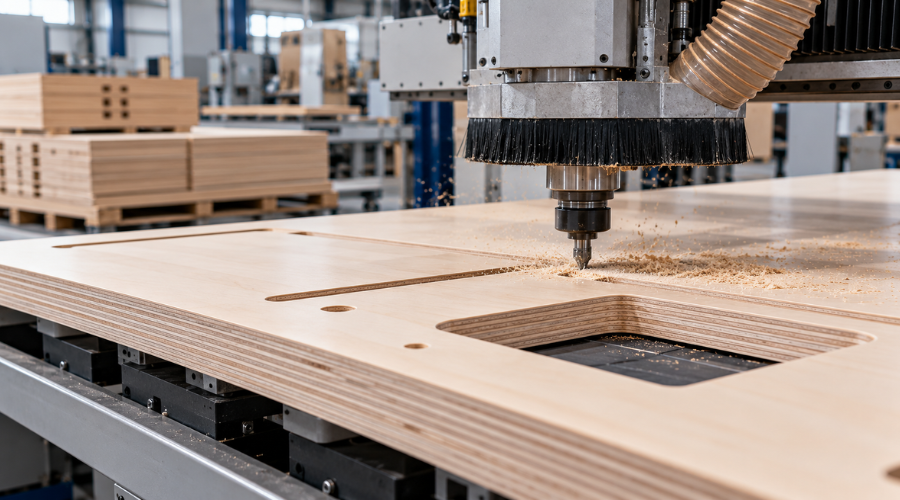
In industrial manufacturing, the performance of plywood is not determined solely by its strength, thickness or surface appearance. Its behaviour during cutting, drilling, CNC routing, milling and finishing can directly affect production efficiency, machining accuracy and the quality of the final component. This is why machinability in industrial plywood manufacturing is a critical factor for companies that depend on consistent, repeatable and cost-efficient production processes.A plywood panel may meet the required dimensions and mechanical specifications while still generating difficulties during transformation. Poor edge quality, veneer tear-out, inconsistent thickness or unexpected machining behaviour can increase material waste, interrupt production lines and create additional finishing operations. When these problems occur repeatedly, their economic impact can become considerably greater than the initial cost of the panel.For manufacturers of furniture components, industrial packaging, vehicle interiors and technical wood products, choosing plywood with the appropriate machining characteristics is therefore a strategic purchasing decision.At CATENVA, we have been manufacturing poplar and pine plywood since 1984. Our experience as an industrial plywood manufacturer allows us to understand how panel composition, veneer characteristics, bonding quality and manufacturing consistency influence subsequent transformation processes. We work with industrial customers to develop plywood solutions adapted to their technical requirements, machining operations and production needs.Understanding machinability is essential not only for improving production performance, but also for selecting a plywood manufacturer capable of delivering reliable material characteristics over time.
Machining performance is closely connected to the quality of the final surface and the finishing operations required after transformation.For manufacturers producing visible furniture components, decorative interiors, laminated panels or coated technical elements, surface consistency is essential.A plywood panel may offer satisfactory mechanical characteristics while presenting surface properties that are unsuitable for a particular finishing process.This distinction is important because machinability in industrial plywood manufacturing includes not only how the material behaves during cutting, but also how efficiently the resulting components can be prepared for their intended finish.Veneer quality can influence the appearance of machined surfaces, while the panel's internal construction affects the regularity of exposed edges.Poorly defined surface requirements may result in additional sanding, filling or repair operations before coating.These processes consume labour, machinery time and finishing materials.When the same operation must be repeated across a large production batch, relatively minor imperfections can create substantial additional costs.For painted or lacquered components, the substrate must be compatible with the intended finishing system.Surface preparation, wood absorption characteristics, moisture and coating formulation all influence the final result. Adhesion and appearance should therefore be validated under actual processing conditions.The same principle applies to laminated plywood components.Adhesive compatibility, surface preparation, pressure and processing conditions must be evaluated to obtain reliable bonding.A panel intended for structural or concealed use does not necessarily need the same face quality as one designed for visible decorative applications.Choosing an unnecessarily high surface grade can increase material cost without providing functional benefits. Conversely, selecting an insufficient grade may create finishing defects and increase rejection rates.At CATENVA, we offer different manufacturing and finishing possibilities according to the intended application. Our objective is to help customers define a panel specification consistent with their production requirements, rather than applying identical characteristics to every use.For industrial buyers, specifying surface quality correctly is therefore an important part of controlling both material cost and manufacturing efficiency.
