In transport applications, reducing weight is a common priority, but it should not become the only criterion when selecting a plywood panel. A lighter material can help optimise payload, facilitate handling or reduce the mass of certain components. However, if it does not provide sufficient dimensional stability, strength or machining consistency, the initial saving can quickly be transferred to production in the form of adjustments, rework, rejected parts or longer assembly times.For this reason, the choice of lightweight plywood for transport applications should be based on the end use rather than on weight alone. At CATENVA, we analyse factors such as the weight-to-strength ratio, moisture, machinability, tolerances, face quality and subsequent finishing requirements in order to adapt the plywood to the customer's production process. The objective is to ensure that the solution performs consistently during manufacturing and does not require problems to be corrected once the component has already entered production.

1. What lightweight plywood for transport applications needs to provide

Lightweight plywood for transport applications should not be selected simply because it weighs less. In vehicle bodies, industrial vehicle conversions, technical furniture, interior linings, auxiliary components or logistics-related solutions, reducing weight can offer significant advantages, but only when that reduction does not create subsequent problems involving strength, stability, machining or assembly.For an industrial company, the relevant question is not simply how many kilograms a plywood panel weighs. The decision should also consider whether the material maintains sufficiently consistent geometry, whether it can be machined repeatedly, whether it can withstand the expected service requirements and whether its faces allow subsequent finishing operations to be carried out correctly. Consistency between batches must also be considered, because a component integrated into serial production needs to behave predictably.For transport applications, lightweight plywood needs to balance five important variables: weight, strength, dimensional stability, machinability and compatibility with the production process. Reducing one of these variables without controlling the others can turn an apparent purchasing optimisation into an increase in total cost.One of the most common mistakes is selecting a panel according to price and weight without defining the application in sufficient detail. Two plywood panels with similar dimensions and thicknesses may behave differently when they are machined, fitted with fasteners, subjected to vibration or processed through lacquering, laminating or covering operations. Assuming that all plywood panels are the same makes it more difficult to anticipate this behaviour and increases the risk of having to make corrections once the material is already in production.The financial impact can then appear at several stages. A panel that requires more preparation increases finishing hours. A material that causes splintering can reduce CNC productivity. A component with dimensional variations may require adjustments during assembly. If the defect is detected only after fittings, coverings or other components have already been added, the cost of rework increases further.At CATENVA, we have been manufacturing poplar and pine plywood since 1984 and approach these projects from an industrial perspective. We analyse the end use, machining requirements, production demands and quality requirements before defining a solution. Our custom plywood manufacturing approach is not simply a matter of changing dimensions: it involves adapting the plywood so that it integrates more effectively into the customer's process.If a company is qualifying a new material, reducing weight in a vehicle or seeking greater consistency on a machining line, the plywood should be assessed as part of the complete application rather than on the basis of a single property.

2. How strong should lightweight plywood for transport be?

Lightweight plywood does not need to provide the maximum possible strength. It needs to provide the appropriate level of strength for the function it will perform. Overspecifying a component can unnecessarily increase weight and cost, while working below the actual requirements can lead to deformation, damage during service or the need to incorporate additional reinforcement.The relationship between weight and strength is therefore one of the main selection criteria in transport applications. Plywood construction, with veneers arranged in alternating directions, helps distribute stresses and provides dimensional stability. However, actual performance depends on factors such as composition, thickness, wood species and the type of load involved.For this reason, lightweight plywood for transport applications should be evaluated according to how the component will actually perform in service. An interior lining does not have the same requirements as a surface subjected to concentrated loads, frequent fastening, vibration or impact. Nor should a specification used for another vehicle or project automatically be applied when dimensions, design or service conditions are different.Simply choosing the lowest-density plywood available may create an apparent saving. If reinforcement then needs to be added, the number of fasteners increased, geometries modified or components replaced, the original cost reduction disappears. The correct calculation should consider the cost of the finished component rather than only the price per square metre.Consistency also has a direct impact on production. When mechanical behaviour and machining remain within predictable parameters, it is easier to standardise speeds, tools, fastening systems and assembly operations. When variability is too high, production has to compensate through additional inspections and manual adjustments.This difference becomes more significant in long production runs. A few additional seconds per component, a small percentage of rejected parts or a slight decrease in machine output can have a much greater financial impact than a moderate difference in the purchase price of the plywood.At CATENVA, we work with poplar and pine plywood and adapt the solution according to the requirements of each project. There is no single configuration that is suitable for every transport application. The correct solution depends on the target weight, the required strength, fastening system, machining requirements and operating conditions.When a customer's objective is to reduce mass without compromising component reliability, we recommend analysing the weight-to-strength balance before finalising the specification. This is particularly relevant in sectors such as caravans and motorhomes, where you can find more information in our article on poplar plywood in caravan design

Tablero contrachapado ligero para carrocerías y vehículos de transporte

3. How moisture and dimensional stability affect transport applications

Dimensional stability is a key factor when plywood has to be integrated with machined parts, profiles, fittings or coverings. Wood is a hygroscopic material and can exchange moisture with its surroundings. Although plywood construction improves stability through its cross-laminated veneer arrangement, storage, machining and service conditions still need to be controlled.In lightweight plywood for transport applications, variations in moisture can lead to dimensional changes, misalignment between drilled holes, assembly difficulties or loss of uniformity in lacquered, laminated or covered surfaces. When these issues appear after machining or finishing, production times increase together with the cost of rework.Moisture and dimensional stability should therefore be evaluated according to the actual service conditions. The objective is not to eliminate every variation inherent to wood, but to work with plywood that is sufficiently consistent to make the production process predictable and compatible with manufacturing tolerances.At CATENVA, we control our production process and treat traceability and consistency as part of the industrial solution. This predictability helps reduce adjustments, additional inspections and the risk of problems affecting subsequent operations.

4. Why machining and tolerances determine the real cost of plywood

In an industrial application, the purchase price of the plywood is only one part of the total cost. Cutting, CNC machining, milling, drilling, edge preparation, fittings and assembly can represent a greater expense if the material does not provide consistent machinability. Splintering, edge defects or variations between components increase cycle times, tool wear and rework.Tolerances should also be defined according to the function of the component. When a dimension affects an assembly, fastening point or subsequent covering operation, a deviation can affect both assembly and production planning. For this reason, with lightweight plywood for transport applications, machining requirements and tolerances should be considered from the specification stage.At CATENVA, we manufacture customised solutions and analyse how the plywood will subsequently be processed, including CNC machining, fastening systems, final geometries and finishes. Adapting the solution to the production process can help reduce waste, handling and machine time.The decision should be based on total cost. A less expensive plywood panel is no longer the lower-cost option if it creates additional machining time, more waste or more components requiring rework. For this reason, performance should be validated under representative conditions before approving a solution for recurring production.

5. How face quality, adhesion and finishes influence performance

In transport applications, the surface quality of the plywood can influence both the final finish and transformation costs. If a component is going to be painted, lacquered, laminated or covered, an unsuitable face may require additional sanding, filling or preparation and increase processing time.Adhesion should also be assessed as part of the complete system. The performance of an adhesive, paint or laminate depends on the surface, the product being applied and the processing conditions. For lightweight plywood for transport applications, it is therefore advisable to define from the outset which finish will be applied and what level of surface quality is actually required.When a defect appears after finishing, the cost increases because machine hours, coatings and handling have already been consumed. The correct level of quality is not necessarily the highest available, but the one that achieves the required result without creating unnecessary operations or rework.At CATENVA, we analyse surface and finishing requirements together with the final application. This customised manufacturing approach helps balance purchase cost, transformation cost and final quality.

6. Uses of plywood in transport applications

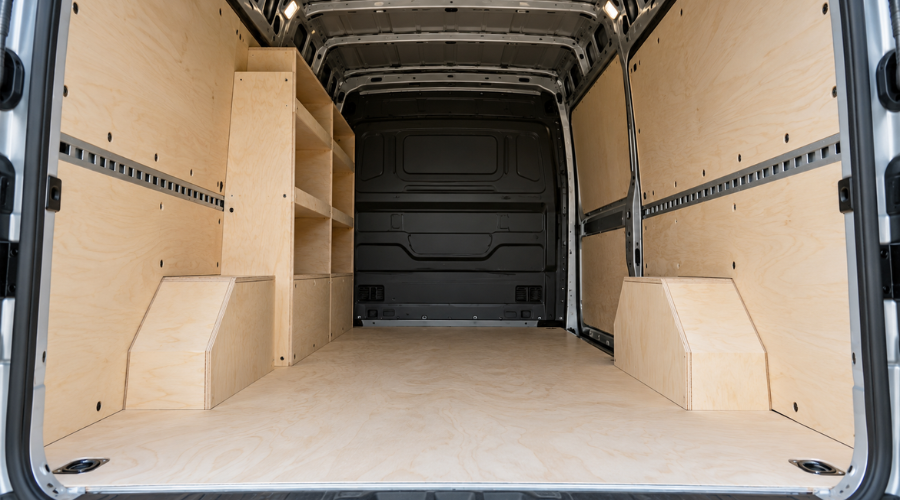
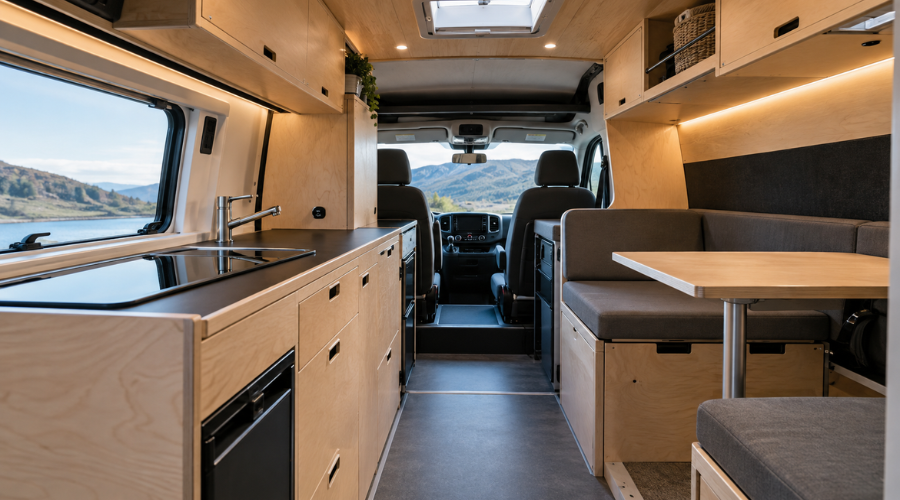
Plywood can be used in different elements of industrial vehicles and transport solutions where the objective is to combine light weight, strength, ease of machining and dimensional stability. Applications may include interior linings, side panels, partitions, technical furniture components, auxiliary structures, flooring and elements integrated into vehicle bodies and specialist conversions.It can also be used in commercial vehicles, converted vans, trailers and transport solutions where the overall weight affects payload capacity or ease of assembly. In these applications, lightweight plywood for transport applications makes it possible to work with custom-machined components adapted to specific geometries, fastening systems and finishes.The choice of plywood always depends on the specific function. A panel intended for interior lining will have different requirements from a component subjected to loads, vibration, impact or moisture. Similarly, a visible surface may require a higher face quality, while a structural or auxiliary component may prioritise strength, stability or machining performance.At CATENVA, we analyse each application before defining the solution. We adapt dimensions, composition, machining and finishing according to the end use so that the plywood responds both to the vehicle requirements and to the needs of the production process.

Contrachapado ligero aplicado al mobiliario interior de vehículos camper

7. How to choose lightweight plywood for transport

The selection process should begin before requesting a price. To correctly define lightweight plywood for transport applications, it is necessary to understand the function of the component, the target weight, its dimensions, how it will be machined, the type of fasteners it will receive, the finish that will be applied and the environmental conditions to which it will be exposed.Expected production volume and supply frequency should also be considered. A technically suitable solution may not be the best option for recurring production if there is insufficient consistency between batches or if supply conditions do not fit the customer's production planning.Machining information is particularly useful. If the component includes milling, drilling, radii, recesses or CNC geometries, knowing these requirements from the outset makes it easier to assess machinability. The same applies to surfaces: if the plywood will ultimately be lacquered, laminated or covered, this should be defined before determining the required face quality.For purchasing departments, this information makes it possible to compare quotations more realistically. For engineering teams, it helps ensure that the material is aligned with the design. For production, it reduces the risk of receiving plywood that later requires unforeseen adaptations. For quality departments, it facilitates the definition of incoming inspection criteria and the maintenance of documentary traceability.Selecting according to price without first defining these variables can result in a misleading comparison. Two proposals may specify the same format and thickness but will not necessarily generate the same cost once they have been machined and assembled. The correct option is the one that helps keep the total cost of the component under control.Documentation should be assessed using the same approach. PEFC certification and FSC certification may be relevant where responsible sourcing and chain-of-custody requirements apply. Quality management requirements may also involveISO 9001.Depending on the end use, other EN or UNE standards may also need to be verified. The applicable documentation should always be assessed according to the specific project.At CATENVA, quality, traceability and certification form part of our industrial approach. More information about our environmental and quality commitments is available on our Quality and Environment page.A customer qualifying a new plywood panel can provide us with information about the application, dimensions, target weight, machining requirements, type of finish, moisture or exposure conditions, approximate production volume and required documentation. With this information, we can assess the project much more accurately than by starting only from a thickness and target price.This technical exchange is also useful when a production problem already exists. If deformation, excessive rework, CNC difficulties, variation between batches or excessive surface preparation time occur, reviewing how the plywood is currently specified can help identify potential areas for improvement.At CATENVA, we manufacture, control and adapt plywood solutions for industrial applications. Our objective is not to propose the plywood with the highest possible specification, but the solution that best responds to the customer's process and end use.

8. Lightweight plywood should be selected according to its end use

Lightweight plywood for transport applications provides value when weight reduction is combined with appropriate strength, dimensional stability, good machinability, moisture control and surface quality compatible with subsequent processing.Incorrect selection can create a chain of consequences that goes far beyond the cost of the plywood itself. It can increase CNC machining times, generate more waste, make assembly more difficult, create rework and affect final quality. If the issue reaches a completed vehicle, the costs of dismantling, replacement, transport and complaint management may also have to be added.By contrast, defining the plywood correctly from the outset helps maintain more stable manufacturing rates, reduce manual intervention and improve process predictability. This is why plywood panels should not be assumed to be identical and why the decision should not be based exclusively on price, weight or thickness.At CATENVA, we manufacture customised plywood panels and advise industrial companies on adapting the product to its end use. We analyse machining, stability, strength, finishing, traceability and supply conditions so that the material fits the customer's production process.If you are qualifying new lightweight plywood for transport applications, want to reduce weight in an existing solution or are experiencing machining, stability or consistency issues,contact our technical team.We can review the project requirements with you before defining the solution.

Frequently Asked Questions

1. Which plywood is most suitable when reducing weight is the priority in transport applications?

It depends on the function of the component. Poplar plywood can be particularly interesting for projects where light weight is a priority, but strength, thickness, machining, fastening systems and service conditions should also be evaluated. Selection should not be based on density alone.

2. Is lightweight plywood necessarily less resistant?

Not necessarily. Strength depends on the composition, thickness, construction of the plywood and the type of stress to which it will be subjected. It is therefore more useful to analyse the weight-to-strength ratio of the complete solution rather than simply comparing the weight of two plywood panels.

3. What should be validated before approving plywood for serial production?

Machining performance, dimensional stability, relevant tolerances, face quality, moisture conditions, fastening systems, subsequent finishing requirements and the required consistency between deliveries should all be assessed. Wherever possible, validation should reproduce actual production conditions.

4. What information does CATENVA need to assess custom plywood for transport applications?

The more information available about the application, dimensions, machining requirements, target weight, finish, environmental conditions, production volume and documentation requirements, the more accurately we can define the solution. The plywood should be specified according to the production process and end use, not only according to its format.

Privacy Preference Center