In industrial manufacturing, the performance of plywood is not determined solely by its strength, thickness or surface appearance. Its behaviour during cutting, drilling, CNC routing, milling and finishing can directly affect production efficiency, machining accuracy and the quality of the final component. This is why machinability in industrial plywood manufacturing is a critical factor for companies that depend on consistent, repeatable and cost-efficient production processes.
A plywood panel may meet the required dimensions and mechanical specifications while still generating difficulties during transformation. Poor edge quality, veneer tear-out, inconsistent thickness or unexpected machining behaviour can increase material waste, interrupt production lines and create additional finishing operations. When these problems occur repeatedly, their economic impact can become considerably greater than the initial cost of the panel.
For manufacturers of furniture components, industrial packaging, vehicle interiors and technical wood products, choosing plywood with the appropriate machining characteristics is therefore a strategic purchasing decision.
At CATENVA, we have been manufacturing poplar and pine plywood since 1984. Our experience as an industrial plywood manufacturer allows us to understand how panel composition, veneer characteristics, bonding quality and manufacturing consistency influence subsequent transformation processes. We work with industrial customers to develop plywood solutions adapted to their technical requirements, machining operations and production needs.
Understanding machinability is essential not only for improving production performance, but also for selecting a plywood manufacturer capable of delivering reliable material characteristics over time.
1. What Is Machinability in Industrial Plywood Manufacturing?
Machinability in industrial plywood manufacturing refers to the ability of a plywood panel to undergo mechanical transformation processes while maintaining the dimensional accuracy, surface quality and structural integrity required by its intended application.
These processes include cutting, sawing, drilling, routing, milling, profiling and other operations performed with conventional woodworking machinery or automated CNC equipment.
A material with suitable machining characteristics should allow manufacturers to achieve consistent results without excessive tool wear, unnecessary material waste or repeated adjustments to production parameters.
However, machinability is not an isolated property. It depends on the interaction between the plywood panel, the cutting tools, the machinery and the machining conditions.
Wood species, veneer orientation, panel density, adhesive distribution and internal construction all influence how the material responds to mechanical processing.
For example, two plywood panels with the same nominal thickness may behave differently during CNC routing if their veneer composition, moisture content or bonding characteristics differ. One may produce clean edges and predictable dimensional results, while the other may require slower processing speeds or additional finishing.
These differences become particularly important in automated manufacturing environments.
When hundreds or thousands of identical parts are produced, consistency matters as much as the performance of an individual panel. Unexpected differences between batches can force operators to modify machining parameters, inspect additional components or interrupt production.
This is why industrial plywood machinability must be evaluated in relation to the complete manufacturing process, rather than simply assessing how easily a panel can be cut.
At CATENVA, we understand that plywood is often an intermediate material within a larger industrial operation. Our approach focuses on supplying panels whose characteristics are adapted to the customer’s intended transformation and final use.
2. How Plywood Composition Influences Cutting and Machining Performance
One of the most important factors affecting machinability in industrial plywood manufacturing is the internal composition of the panel.
Plywood is produced by bonding several wood veneers together, typically with adjacent layers arranged in alternating grain directions. This construction contributes to dimensional stability and mechanical performance, but it also creates specific machining conditions.
During cutting or milling, tools interact with veneers whose fibres run in different directions. Consequently, cutting resistance and surface behaviour can vary as the tool passes through the panel.
The quality and arrangement of these veneers influence edge regularity, surface tearing and the risk of defects appearing during transformation.
Wood species is another determining factor.
Poplar plywood is particularly interesting for applications requiring relatively low weight and efficient machining. Its comparatively low density can be advantageous in certain cutting and routing operations, although the final result depends on tool geometry, machining parameters and panel construction.
Pine plywood may present different characteristics due to variations in density, hardness and grain structure. Depending on the intended application, these differences can influence cutting forces, surface finish and tool performance.
However, it would be inaccurate to assume that one species always offers better machinability than another.
A well-manufactured plywood panel with an appropriate composition may perform more consistently than a poorly specified alternative, regardless of the wood species.
Adhesive bonding also deserves consideration. The adhesive system and its distribution influence internal integrity, while glue lines can affect cutting-tool interaction. Inadequate bonding may contribute to delamination or edge defects during machining, particularly when components are exposed to additional mechanical stress.
Moisture content is equally relevant. Wood responds to environmental humidity, and changes in moisture can influence dimensional behaviour and cutting performance.
Machining panels before they have reached conditions compatible with the production environment may introduce dimensional variations that become apparent after cutting or assembly.
These problems can lead to inaccurate components, rejected parts and additional production time.
At CATENVA, we manufacture poplar and pine plywood with different composition and dimensional possibilities. When assessing a project, we consider the intended application and transformation requirements so that panel selection supports the customer’s manufacturing objectives.
3. CNC Machining, Drilling and Milling: Why Panel Quality Matters
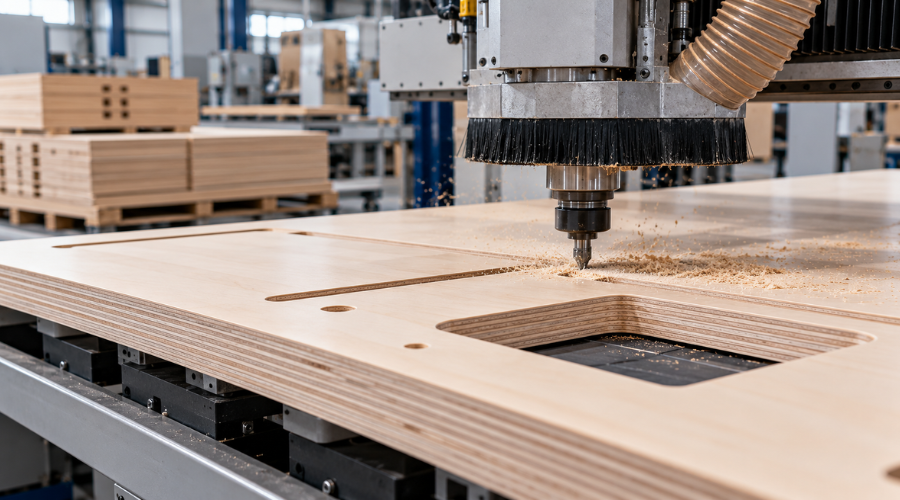
CNC technology has become an essential part of many industrial woodworking processes because it allows manufacturers to produce complex shapes, repeatable components and accurately positioned machining operations.
Nevertheless, automated machinery cannot fully compensate for inconsistent raw materials.
Machinability in industrial plywood manufacturing becomes especially important when panels are processed through CNC routing centres, automated drilling lines or high-volume cutting equipment.
In these environments, dimensional consistency helps ensure that programmed operations produce the expected result.
Variations in thickness may influence cutting depth, groove geometry or the position of mechanical connections. Internal voids or unsuitable veneer configurations can affect edge quality and the behaviour of certain fastening points.
When a component must fit into a larger assembly, even relatively small dimensional deviations may cause difficulties.
This is particularly relevant in the manufacture of technical furniture, industrial enclosures, vehicle interiors and components assembled using mechanical fittings.
For instance, a manufacturer producing plywood partitions with CNC-machined connection points requires predictable thickness and stable panel dimensions. If these conditions change between deliveries, components may need additional adjustments before assembly.
Drilling performance is another important factor.
Poor machining conditions or unsuitable panel characteristics may cause veneer splintering around holes, irregular edges or reduced fastening quality.
The result can be additional finishing operations, rejected components or reduced reliability of assembled products.
Milling and profiling introduce similar challenges, especially when the design requires exposed edges, curved geometries or precise recesses.
Tool selection, feed rate, spindle speed, cutting direction and extraction systems must be adapted to the material and operation. These parameters should be established through appropriate production trials rather than assuming that every plywood panel behaves identically.
Tool wear also has an economic impact.
If a manufacturing process requires frequent tool replacement, lower machining speeds or repeated manual corrections, the total processing cost can increase significantly.
A material selected without considering machining requirements may therefore become more expensive than a technically better-suited alternative.
At CATENVA, we work with industrial customers to understand their production methods and assess suitable plywood characteristics before defining a custom manufacturing solution.
 4. Surface Quality, Edge Finishing and Compatibility with Industrial Coatings
 4. Surface Quality, Edge Finishing and Compatibility with Industrial Coatings
Machining performance is closely connected to the quality of the final surface and the finishing operations required after transformation.
For manufacturers producing visible furniture components, decorative interiors, laminated panels or coated technical elements, surface consistency is essential.
A plywood panel may offer satisfactory mechanical characteristics while presenting surface properties that are unsuitable for a particular finishing process.
This distinction is important because machinability in industrial plywood manufacturing includes not only how the material behaves during cutting, but also how efficiently the resulting components can be prepared for their intended finish.
Veneer quality can influence the appearance of machined surfaces, while the panel’s internal construction affects the regularity of exposed edges.
Poorly defined surface requirements may result in additional sanding, filling or repair operations before coating.
These processes consume labour, machinery time and finishing materials.
When the same operation must be repeated across a large production batch, relatively minor imperfections can create substantial additional costs.
For painted or lacquered components, the substrate must be compatible with the intended finishing system.
Surface preparation, wood absorption characteristics, moisture and coating formulation all influence the final result. Adhesion and appearance should therefore be validated under actual processing conditions.
The same principle applies to laminated plywood components.
Adhesive compatibility, surface preparation, pressure and processing conditions must be evaluated to obtain reliable bonding.
A panel intended for structural or concealed use does not necessarily need the same face quality as one designed for visible decorative applications.
Choosing an unnecessarily high surface grade can increase material cost without providing functional benefits. Conversely, selecting an insufficient grade may create finishing defects and increase rejection rates.
At CATENVA, we offer different manufacturing and finishing possibilities according to the intended application. Our objective is to help customers define a panel specification consistent with their production requirements, rather than applying identical characteristics to every use.
For industrial buyers, specifying surface quality correctly is therefore an important part of controlling both material cost and manufacturing efficiency.
5. Common Machining Problems and Their Impact on Industrial Production Costs
A poor assessment of machinability in industrial plywood manufacturing can introduce problems that extend well beyond the machining station.
One frequent purchasing mistake is selecting plywood primarily according to its initial price, without evaluating how the material behaves during processing.
A cheaper panel may appear attractive during procurement, but this advantage can disappear if it generates additional machining time, greater waste or more frequent quality defects.
Veneer tear-out is one example.
When cutting conditions are unsuitable or the panel does not have the characteristics required for the operation, the exposed fibres may break irregularly. This can result in unacceptable edges, especially in visible components.
If the defect requires sanding or reworking, the manufacturer must allocate additional labour and machine capacity.
Dimensional instability creates another source of cost.
When moisture content, storage conditions or panel consistency are not adequately considered, components may change dimensions after cutting.
This can affect subsequent assembly operations and create difficulties in maintaining the required tolerances.
A component that fails to fit correctly may require machining adjustments or complete replacement.
The economic impact becomes more serious in continuous production lines.
If a recurring defect affects numerous components, the consequences can include production interruptions, delivery delays, increased material consumption and higher inspection costs.
Another common mistake is assuming that all plywood panels of the same nominal thickness are interchangeable.
In practice, the wood species, internal composition, adhesive system, surface quality and dimensional tolerances may differ.
These variations can significantly affect manufacturing performance.
Ignoring the final application also leads to inefficient purchasing decisions.
A panel intended for simple packaging components may require different characteristics from one designed for precision CNC machining or high-quality lamination.
When these requirements are not established before purchasing, manufacturers risk paying for unnecessary features or receiving a product that does not meet essential processing needs.
The correct economic evaluation therefore considers the complete production process.
A suitable plywood panel can help reduce rejected components, unnecessary tool adjustments, rework and material waste. The extent of these benefits depends on the application and should be verified against actual production data.
At CATENVA, we understand that industrial customers need predictable material behaviour. This is why we encourage technical discussions that address manufacturing requirements before finalising a plywood specification.
6. How to Choose Plywood for Efficient and Repeatable Manufacturing
Selecting plywood for an industrial machining process requires more than identifying the appropriate panel thickness or nominal dimensions.
The first step is to define the intended application and understand the operations the material will undergo.
For instance, a panel that will only be cut into rectangular packaging components may have different requirements from a panel that must be CNC-routed, drilled, laminated and assembled into a technical structure.
The complexity of the machining process directly influences the importance of dimensional tolerances, veneer quality and internal panel consistency.
Machinability in industrial plywood manufacturing should therefore be considered during the specification stage, not after production difficulties appear.
One important criterion is the relationship between wood species and machining requirements.
Poplar plywood may be particularly suitable where reduced weight and machining efficiency are priorities. Pine plywood may provide alternatives when other mechanical or surface characteristics are required.
The correct solution depends on the final use, and comparative machining trials can be valuable when the project involves demanding tolerances or high production volumes.
Panel thickness and dimensional consistency should also be assessed in relation to the manufacturing equipment.
When CNC machines operate with fixed reference surfaces or programmed cutting depths, variations in thickness may affect the accuracy of the final component.
Surface quality must be specified according to the finishing process. Panels designed for painting or lamination should be evaluated for their compatibility with the chosen coating or bonding system.
Storage conditions also need attention.
Plywood should be handled and stored in conditions appropriate to its intended use, avoiding unnecessary exposure to moisture and conditions that may cause deformation.
For companies with recurring production programmes, supply consistency is particularly important.
A panel that performs satisfactorily during an initial production trial must also demonstrate appropriate consistency in subsequent deliveries.
Clear technical specifications, quality control and communication with the manufacturer help establish a more predictable purchasing and production process.
At CATENVA, we advise industrial customers on the selection and adaptation of plywood according to their technical requirements. Our manufacturing approach allows us to consider dimensions, composition and finishing needs while evaluating production feasibility.
Companies developing new products or reviewing their current material specifications can contact our technical team to discuss the characteristics required for their manufacturing operations.
7. Why Work Directly with a Custom Industrial Plywood Manufacturer?
For industrial companies, the relationship with a plywood supplier should go beyond negotiating prices and delivery schedules.
When plywood forms part of a repetitive manufacturing process, the ability to discuss technical requirements directly with the manufacturer becomes especially valuable.
A specialised manufacturer can help evaluate whether a standard panel is appropriate or whether the application would benefit from a different composition, dimension or finish.
This is particularly relevant when machining precision, material efficiency and manufacturing consistency are important purchasing criteria.
At CATENVA, we have been manufacturing plywood since 1984, developing solutions for industrial packaging, furniture, transport and other technical applications.
We manufacture poplar and pine plywood and work with customers to adapt panel characteristics to their intended use.
Our approach combines manufacturing knowledge, control of the production process and technical advice.
Rather than treating plywood exclusively as a standard commodity, we analyse how its characteristics influence the customer’s transformation process and final product.
This approach is especially important when production involves CNC machinery, repetitive assembly operations or specific surface finishes.
Working directly with a manufacturer can also facilitate the definition of purchasing specifications and quality requirements.
For businesses operating under documented quality systems, traceability and appropriate certification can provide additional support for procurement and auditing processes.
Our quality framework includes ISO 9001 certification, while PEFC and FSC certification options are available according to their applicable scope and ordering conditions. Current certificate validity and product coverage should always be verified.
For additional information about these management and traceability frameworks, consult the official resources from ISO, PEFC and FSC.
You can also review our quality policy and certification documentation.
These certifications support particular aspects of quality management or material traceability, but they do not replace technical validation of machining performance.
Ultimately, the objective is to establish a supply relationship that supports the customer’s production process.
If your company requires custom plywood panels with characteristics adapted to CNC machining, industrial cutting, surface finishing or repetitive manufacturing, contact our technical team. At CATENVA, we can assess your application and discuss a solution tailored to your manufacturing requirements.
8. Conclusion: Machinability as a Competitive Advantage in Industrial Manufacturing
Machinability in industrial plywood manufacturing is a determining factor for companies seeking to improve production efficiency, dimensional precision and finished-product quality.
Selecting the right plywood can contribute to cleaner cutting, more consistent CNC machining, reduced rework and improved material utilisation.
However, these benefits depend on choosing a panel whose composition, surface quality, dimensional characteristics and moisture conditions are compatible with the manufacturing process.
An unsuitable material can create additional costs through rejected components, machine adjustments, production delays and quality incidents.
For industrial buyers and production managers, plywood selection should therefore be approached as a technical decision with direct economic consequences.
At CATENVA, we manufacture poplar and pine plywood with a focus on industrial applications, customisation and consistent production requirements. Our experience since 1984 allows us to work with customers who need more than a standard plywood panel: they need a material solution adapted to their manufacturing process.
If you are looking for a reliable industrial plywood manufacturer capable of understanding your technical requirements, we are ready to discuss your project.
Contact CATENVA to explore custom plywood solutions for your industrial production needs.
9. Frequently Asked Questions About Industrial Plywood Machinability
What makes plywood suitable for CNC machining?
Plywood suitable for CNC machining should provide consistent thickness, appropriate veneer quality, sound internal bonding and dimensional characteristics compatible with the intended operation. Actual performance also depends on cutting tools, machine settings, feed rates and the complexity of the component.
Is poplar plywood easier to machine than pine plywood?
Poplar plywood can offer advantages in certain machining operations due to its relatively low density. However, performance depends on the complete panel construction, tool selection and processing conditions. Pine plywood may be preferable for applications requiring different mechanical characteristics. Comparative trials are advisable when machining requirements are demanding.
How does plywood quality affect industrial machining costs?
Panel quality can influence cutting accuracy, edge finish, tool performance and component rejection rates. Inconsistent material characteristics may increase machine adjustments, manual finishing, waste and production interruptions. Selecting plywood adapted to the manufacturing process can help control these costs.
Can CATENVA manufacture plywood adapted to specific industrial machining requirements?
Yes. At CATENVA, we manufacture poplar and pine plywood with different possibilities for dimensions, composition and finishes. We assess the customer’s application and technical needs to develop a suitable solution, subject to manufacturing feasibility and agreed specifications.