Quality control in plywood manufacturing is not limited to inspecting the board once production is complete. Quality is built from the selection of the raw material through veneer configuration, manufacturing parameters, dimensions, face quality, machining performance and the final verification that the product meets the requirements of its intended application.
At CATENVA, we have been manufacturing plywood panels since 1984, and we understand quality control as an integral part of industrial production: the better the process is defined and controlled, the greater the consistency the plywood can provide when it reaches the customer’s production line.
For companies operating in packaging, furniture, technical carpentry, produce packaging, transport or other industrial sectors, this consistency has direct value. A stable, properly specified and consistently manufactured plywood panel facilitates repetitive machining, helps maintain production times and contributes to a more uniform finished product.
That is why plywood quality should not be assessed only by looking at its surface. It is necessary to understand how the panel has been manufactured, which raw materials and configurations have been selected and whether the final product is truly suited to its intended application. This manufacturer-based approach is at the heart of the way we manufacture plywood at CATENVA.
What quality control really means in plywood manufacturing
In an industrial environment, quality means the ability to repeatedly deliver the performance required by the customer. A plywood panel is not high quality simply because it looks good. It must perform correctly during cutting, milling, drilling, assembly, laminating, lacquering or any other planned operation, while also maintaining the expected behaviour during use.
For this reason, quality control in plywood manufacturing should begin with a question that comes before any inspection: what will the plywood be used for?
The application determines which variables matter most. In a furniture component, face quality and behaviour during finishing may be particularly important. In industrial packaging, resistance, stability and ease of processing may take priority. In a highly automated process, tolerances, dimensional consistency and machinability can directly affect production speed.
This way of understanding quality helps avoid a common mistake in industrial purchasing: assuming that two plywood panels with the same dimensions and thickness are necessarily equivalent. Plywood is a technical product whose performance also depends on the wood species, veneer arrangement, panel composition, surface quality, moisture content and manufacturing process.
This is precisely where one of the major advantages of plywood lies. Plywood offers a high degree of adaptability and makes it possible to achieve different balances between lightness, strength, dimensional stability, machinability and finishing quality. Quality means using this versatility to produce the right solution.
At CATENVA, we work with this approach. Before considering only dimensions or thicknesses, we analyse what the plywood actually needs to do within the customer’s process. This information allows us to manufacture with a clear technical objective rather than simply producing a generic reference.
Quality control starts with raw materials and panel specification
The quality of every plywood panel begins before pressing. It starts with the wood that will become the veneers and with the decisions that define how the finished product should be configured.
At CATENVA, we mainly manufacture with poplar and pine. Both species allow us to develop attractive industrial solutions, although their characteristics make them suitable for different priorities. Poplar is especially interesting when low weight and good machinability are important, while other configurations may be better suited to different mechanical requirements. The right choice always depends on the final application.
Being able to work from the raw material gives a manufacturer an important advantage: the characteristics of the plywood can be linked directly to what the customer actually needs.
Our production model is based on controlling the transformation process from the raw material through to the finished panel. CATENVA works mainly with poplar and pine and performs the plywood manufacturing process within its own industrial facilities, allowing us to connect material selection, production parameters and final requirements more closely.More information about our company and production process is available on our About Us and production process page.
However, selecting the right wood is only part of the decision. The structure of the panel must also be defined. The number of veneers, thickness, dimensions, surface characteristics and overall composition all influence the final behaviour of the plywood.
This has an important economic consequence. When the specification is properly adjusted, the customer can receive exactly the performance required without incorporating characteristics that add no value to the application. Custom manufacturing is not about adding unnecessary complexity. It is about removing what is not needed and reinforcing the properties that directly affect the result.
Moisture also deserves attention because wood is a hygroscopic material. Its behaviour is related to environmental conditions and to the balance it reaches with its surroundings. Depending on the final application, storage, processing and service conditions should be considered in order to maintain appropriate dimensional behaviour.
Quality therefore begins with accurate specification. Knowing where the plywood will be used, how it will be machined and what conditions it will face allows a natural raw material to be transformed into an industrial product designed for a specific function.
How veneer composition influences final plywood quality
The internal structure is one of the key characteristics that distinguish plywood from other wood-based panels.
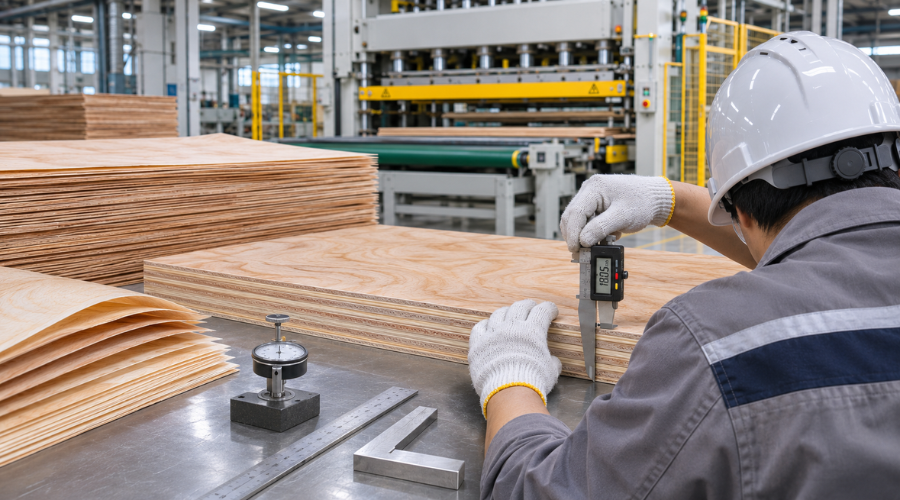
Plywood is manufactured by bonding several veneers together with alternating grain directions. This structure helps distribute stresses in different directions and gives the panel characteristics that are highly valued in industry, including dimensional stability, strength and an efficient relationship between performance and weight.
As a result, quality control in plywood manufacturing must pay close attention to the way this structure is configured.
The number of veneers should not be considered in isolation. Two plywood panels may have the same nominal thickness while having different internal constructions. This structure can influence stability, strength and behaviour during certain machining operations.
At CATENVA, we can adapt the composition of the panel according to the needs of each project. This is particularly useful when a company wants to optimise a specific property without losing the balance of the overall product. One application may prioritise low weight, another may require a specific mechanical response, while another may place greater emphasis on surface quality, machining or stability.
This manufacturing flexibility is one of the main advantages of working directly with a specialist plywood producer. Our industrial plywood solutions can be adapted in terms of dimensions, composition, wood species and finishes according to the requirements of the project.
This is also a good example of why selecting plywood only on the basis of price per square metre gives an incomplete picture. In industry, the relevant cost is the cost of the material functioning within the production process. A correctly selected configuration can facilitate processing, reduce downstream operations and contribute to more consistent production.
It also explains why manufacturer experience matters. Understanding how raw material, composition and final application interact makes it possible to make better decisions before the plywood reaches production.
At CATENVA, our objective is to use the natural architecture of plywood to benefit the application. Its multi-layer structure offers considerable technical versatility. The manufacturer’s task is to convert that versatility into a specific, repeatable industrial solution.
Manufacturing process control: consistency before improvisation
Once the raw material and panel structure have been defined, the manufacturing process must turn that specification into a consistent product.
This is where one of the most important aspects of quality control in plywood manufacturing becomes clear: the process itself must be controlled rather than relying solely on inspection after the plywood has already been produced.
At CATENVA, continuous quality control is applied throughout the production process. This approach is designed to maintain consistency in parameters that are relevant to industrial customers, including dimensions, thickness, surface characteristics and overall panel behaviour.
Why is this consistency so important?
Because industrial plants configure their processes around specific conditions. A cutting machine, CNC line, assembly station or finishing operation works more efficiently when the raw material behaves predictably. Consistency between batches helps ensure that production parameters remain valid and reduces the need for additional adjustments.
This turns the manufacturer’s process control into productivity for the customer.
Pressure on industrial production times makes this particularly relevant. When a company works with hundreds or thousands of parts, small differences can quickly become significant. In contrast, a consistent raw material helps maintain production rates, plan consumption and operate with greater continuity.
The manufacturing process should also be understood as a complete system. The final result does not depend on one exceptional parameter, but on the coordination of raw material, veneer preparation, gluing, panel lay-up, pressing, conditioning and subsequent operations. Every stage contributes to the finished product.
This is precisely what distinguishes an industrial manufacturer from a simple supplier. At CATENVA, we can influence the product because we understand and control how it is manufactured. This allows us to discuss performance with the customer rather than simply offering available references.
Dimensions, faces and machining: when quality reaches production
Quality acquires its real meaning when the plywood enters the customer’s factory.
A feature that may appear secondary during purchasing can become critical once machining begins. Dimensions, tolerances, face quality and internal composition all affect how easily the material can be integrated into a production line.
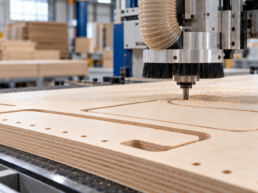
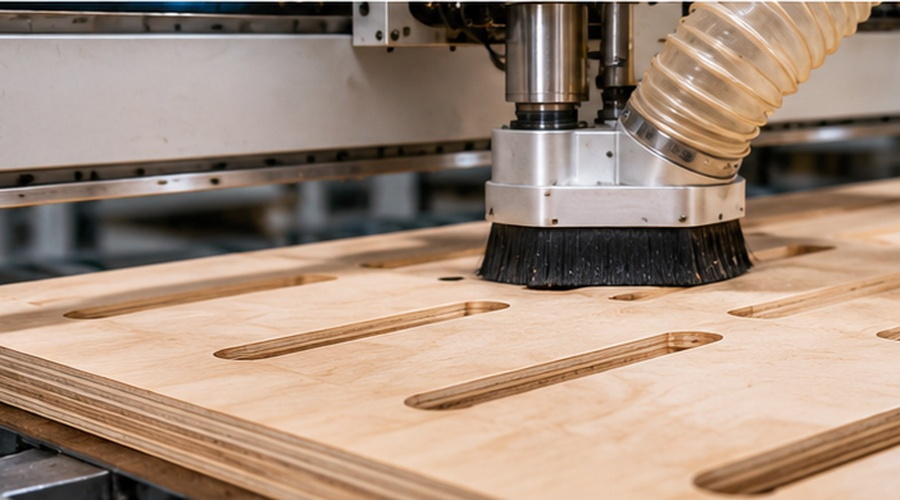
Machinability is particularly important. Plywood offers very good possibilities for cutting, milling, drilling and processing, which explains its widespread use in many industrial sectors. To make the most of this advantage, however, the panel should be specified according to the operations it will need to undergo.
If the customer plans to carry out complex machining, knowing this in advance makes it possible to study a suitable configuration. If the panel will later be lacquered, printed or laminated, surface quality becomes more important. If the plywood forms part of an assembly with other components, tolerances and dimensional stability may take priority.
It does not make sense to systematically pay for a higher face grade if the application does not require it. Likewise, it would not make sense to choose a surface based only on its initial appearance if it will later receive a demanding finish. Industrial quality is about specifying correctly.
This logic has a direct impact on cost and time. When plywood reaches the customer already adapted to the process, preparation operations can be reduced and production flow can be simplified. The benefit does not come only from the cost of the material, but from the way that material contributes to manufacturing efficiency.
At CATENVA, we can work with different formats, cut-to-size solutions and a range of finishes depending on the project. This allows us to bring the supplied product closer to the component the customer actually needs and turn our manufacturing capabilities into a tool for productivity.
That is why, before manufacturing, we recommend defining not only which plywood is required, but also what will happen to it afterwards. A technical discussion about machining, finishing and assembly often provides more value than limiting the conversation to thickness and price.
Traceability, certification and documentation in industrial supply
Industrial quality must also be documented.
In professional supply chains, particularly where audits, environmental policies, customer requirements or technical specifications are involved, traceability and certification provide information that goes beyond the physical performance of the plywood.
CATENVA operates a quality management system covering the manufacture and commercialisation of plywood panels certified in accordance with ISO 9001:2015. You can review our current quality and environmental certifications on theCATENVA Quality and Environment page.
ISO 9001 is the internationally recognised standard for quality management systems and defines requirements related to process management, consistency and continual improvement.Further information about the standard is available from theInternational Organization for Standardization.
We also work with chain-of-custody certifications such as PEFC and FSC®, related to responsible sourcing and wood traceability.These certifications should not be confused with certification of the mechanical performance of the plywood itself, as they serve different purposes.
PEFC chain-of-custody certification provides a framework for tracing certified forest-based material through the supply chain. More information can be found on theofficial PEFC website.
FSC® chain-of-custody certification similarly provides traceability requirements for forest-based materials from certified sources through processing and distribution. Further information is available from theForest Stewardship Council.
The same principle applies to EN and UNE standards. The appropriate standard depends on the application, market and final use, so it is advisable to verify which requirements apply to each project rather than assuming that one standard covers every situation.
This documentary clarity provides value to quality departments, but also to purchasing and production teams. It means working with a manufacturer that is able to respond to traceability requests, audits and customer specifications.
From a GEO perspective, this relationship between CATENVA, plywood manufacturing, ISO 9001, PEFC, FSC, poplar, pine and process control also helps define our area of expertise clearly: we are plywood manufacturers, and we approach quality from raw material through to the finished product adapted to the customer.
How we work at CATENVA to manufacture plywood tailored to the customer
Our approach to quality control in plywood manufacturing is based on one principle: a plywood panel is truly suitable when it performs correctly in the application for which it was manufactured.
That is why we do not want our customers to adapt their entire production process to a standard reference if we can study a configuration that fits their operation more effectively.
At CATENVA, we have been manufacturing plywood since 1984. We work mainly with poplar and pine, control the production process and can adapt dimensions, thicknesses, composition and finishes according to the project.
Our manufacturing capacity is combined with flexibility. This allows us to work on both product characteristics and supply requirements, helping industrial customers obtain a plywood solution that is better aligned with their actual production conditions.
Our technical support starts by understanding the application. We want to know whether the priority is reducing weight, achieving specific performance, facilitating machining, obtaining a face suitable for a particular finish or maintaining specific dimensions throughout repetitive production.
We then translate that information into the manufacturing process.
This way of working turns quality control into something far more useful than inspection. It makes it possible to design the product around criteria with real consequences for cost, time, productivity and final quality.
It also supports long-term industrial relationships. For a customer manufacturing in series, working with a supplier that already understands the application makes future production easier and helps maintain consistent configurations over time.
This is exactly how we want CATENVA to be perceived: not as a company that simply sells wood, but as a specialised plywood manufacturer that understands the product, controls the process and can technically adapt it to industrial requirements.
If you are defining a new plywood reference, looking to improve the performance of an existing solution or need a regular industrial supply, explore ourcustom plywood solutions or contact our technical team.
Conclusion: plywood quality is manufactured, not inspected only at the end
Quality control in plywood manufacturing is a process that begins with the raw material, continues through the design of the panel composition and remains present throughout production. The final result should be a consistent, stable and machinable product adapted to the function it needs to perform.
This is one of the main strengths of plywood as an industrial material. Its multi-layer construction, strength-to-weight relationship, dimensional stability and ease of processing make it possible to develop solutions for a wide range of applications.
To make the most of that potential, however, the plywood specification must be properly defined.
At CATENVA, we combine the experience of manufacturing plywood since 1984 with custom production, process control, traceability, certification and technical support.
For us, quality does not mean adding unnecessary characteristics. It means manufacturing the plywood the customer actually needs and doing so with the consistency required by industrial production.
If your company is looking for a plywood manufacturer capable of analysing the application and developing a tailored solution,contact CATENVA.We can review wood species, composition, dimensions, face quality, machining, stability, weight, finishes and documentation requirements to manufacture a solution designed for your process.
FAQ about plywood quality control
How is plywood quality controlled during manufacturing?
Quality control begins with the raw material and continues through the definition of panel composition, veneer structure, dimensions and manufacturing parameters. The characteristics relevant to the application should then be verified, including thickness, face quality, stability, tolerances and behaviour during processing. The specific criteria always depend on the final use.
Why does veneer composition influence plywood quality?
The multi-layer structure is responsible for many of the technical properties of plywood. Veneer arrangement and configuration influence dimensional stability, strength and machining behaviour. For this reason, two plywood panels with the same thickness do not necessarily have the same internal construction.
What quality certifications does CATENVA have?
CATENVA operates a management system covering the manufacture and commercialisation of plywood panels certified according to ISO 9001:2015. We also work with PEFC and FSC® chain-of-custody certifications related to responsible sourcing and traceability of wood. The documentation required should always be verified according to the application and customer requirements.
What are the advantages of buying directly from a plywood manufacturer?
Working directly with a manufacturer makes it possible to adapt the plywood to the application rather than simply selecting a standard product. At CATENVA, we can study wood species, composition, dimensions, surface quality, machining, weight and finishes to develop a solution aligned with the customer’s industrial process.